

“The main purpose of dot density mapping is to communicate variation in spatial density. [We] will explore dot density mapping using the same data set (2014 population data) obtained from the previous lab.”
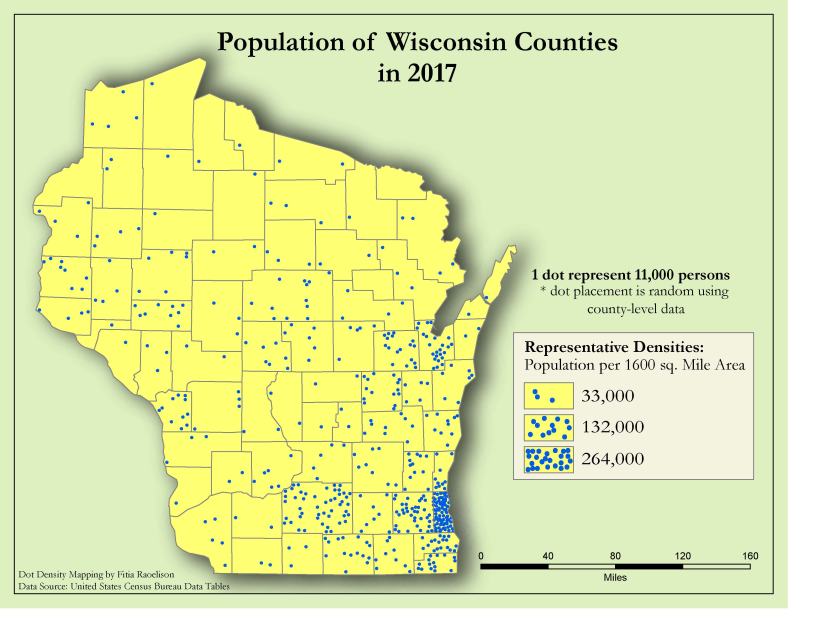
What dot size and units per dot did you use? Look at the map you created and explain whether your map effectively conveys an underlying message (population density) to the audience. If not, what would you change and how could you correct it? I used 1 dot which represent 11,000 persons at random placement using county-level data. By looking at the map, using this dot size allows the data to look evenly spread out across the state. According the map, there are more people living near the coast where it’s touching Lake Michigan.
Explain the pattern you see on the dot density map. Is the pattern shown on the dot density map similar to any of those created by the choropleth technique? Further south, there are dots appearing which means larger population and if we go farther north, most counties have at least three dots, which means a small population. The pattern on the map is similar to those created by chloropleth technique because chloropleth mapping displays divided geographical areas or regions that are colored, shaded or patterned in relation to a data variable
What problems did you encounter while assigning a dot value for phenomenon with a very large data range? It was difficult to find a good dot value that could give the map a good balance between the values in each county. If I had used a small dot value less than 10,000 persons, the most populated county would’ve blended together and hard to distinguish. If I had used a larger dot value greater 15,000 persons, the dots would appear to be spaced far part in dense areas and even more so in sparse areas. To fix this, I had to find a good value between 10,000 and 15,000 that could give that balance.
Does the political unit control the dot placement? Once the county lines are removed, does the “boundary effect” still appear on your map? Yes. These boundaries may have been devised only for enumeration purposes, thus they should not be used to dictate the location of the dots. For example, population settlements occur irrespective of political boundaries, and under these circumstances, dots should be placed on or very near the boundary line. Doing otherwise would result in a map with areas that are clearly separated by white lines.
 F.H.R VERSE